
How Chhatrapati Shivaji Maharaj Outsmarted Aurangzeb in the Legendary 1666 Agra Escape
Inside the diplomatic trap at the Mughal court, the strategic illness feint, and the daring logistics behind Shivaji Maharaj's legendary 1666 escape from Agra.

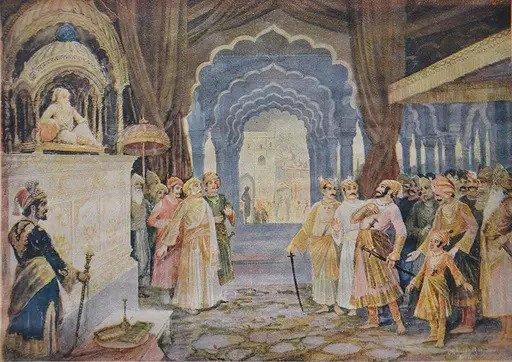
On the sultry afternoon of May 12, 1666, the Diwan-i-Khas inside the Agra Fort was arranged with the calculated theatricality that defined the zenith of the Mughal Empire. Emperor Muhi-ud-Din Muhammad Aurangzeb Alamgir sat elevated upon his throne, celebrating his fiftieth lunar birthday. Courtiers stood in rigid, tiered rows according to their rank—their eyes cast downward in prostration, perfumed with rose attar, and surrounded by silver railings. Yet, within minutes, the calculated symmetry of the court was shattered by an open act of defiance that sent imperial chobdars reaching for their maces.
A thirty-six-year-old Maratha leader, Shivaji Bhonsle, refused to accept the subordinate station assigned to him. He stepped out of rank, turned his back on the throne, and declared in full view of the Mughal grandees that he would rather face death than endure dishonor.
What began as a delicate diplomatic negotiation between two titan figures of seventeenth-century India spiraled into the legendary Agra Escape, one of the most daring operations in world history. Within ninety-nine days, Shivaji transformed a closely guarded house arrest—surrounded by thousands of imperial musketeers—into an embarrassment so profound that Aurangzeb, in his dying days four decades later, would still lament it in his private letters as the fatal blunder of his reign.
I. The Road to Agra: The Rajput Guarantee
To understand why Shivaji traveled nearly nine hundred miles north into the lion’s den of Agra, one must examine the aftermath of the Treaty of Purandar (June 1665).
The imperial veteran Mirza Raja Jai Singh I—head of the Kachhwaha Rajput clan of Amber—had besieged Maratha territory with suffocating military pressure. Recognizing the tactical reality, Shivaji chose diplomacy over a war of attrition. Under the terms of Purandar, Shivaji surrendered twenty-three of his thirty-five forts and agreed to enter imperial vassalage.
"Mirza Raja was an astute statesman of the old school. He knew that brute force could conquer hill-forts, but only conciliation could tame the Deccan. He held out the bait of high imperial rank, viceroyalty of the Mughal Deccan, and the conquest of Bijapur to induce Shivaji to visit the Emperor’s court."
— Sir Jadunath Sarkar, Shivaji and His Times (1920)
Shivaji was deeply suspicious of Mughal intentions, having already survived the ambush of Afzal Khan in 1659 and the night raid on Shaista Khan in Pune in 1663. He demanded guarantees that went beyond imperial firmans.
Jai Singh gave his own solemn oath: he swore upon his Rajput honor and the sacred water of the Ganges, pledging the personal protection of his son and heir, Kumar Ram Singh, who was stationed at the imperial court in Agra. Setting the stage for the legendary Agra Escape, accompanied by his nine-year-old son Sambhaji, seven high ministers, 250 cavalrymen, and 1,000 infantrymen, Shivaji rode toward Agra not as a conquered rebel, but as a sovereign ruler expecting an alliance of equals.
II. The May 12 Confrontation: Insult at the Diwan-i-Khas
The reception at Agra on May 12 was cold from the outset. Instead of prime ministers welcoming him at the city gates, Shivaji was received only by Kumar Ram Singh and a minor official, Mukhlis Khan. Swallowing the slight, Shivaji entered the Red Fort's Diwan-i-Khas (Hall of Private Audiences).
The Confrontation in the Diwan-i-Khas (May 12, 1666)
1. The Cold Presentation: Kumar Ram Singh escorted Shivaji to the throne. Shivaji presented 1,000 gold mohurs and 2,000 silver rupees. Aurangzeb accepted in icy silence without presenting a single robe of honor (Khilat)—a deliberate diplomatic snub.
2. The Rank: Led back to the third row among 5,000-rank mansabdars, Shivaji noticed a grandee standing ahead of him:
Shivaji: "Ram Singh ji, who is that noble standing ahead of me in this row?"
Kumar Ram Singh: "He is Maharaja Jaswant Singh of Marwar."Shivaji: "Jaswant Singh? Whose soldiers turned their backs and fled before my men in the Deccan? My nine-year-old son Sambhaji was granted a 5,000 rank without lifting a sword! Am I, who carved a kingdom by the edge of the blade, to be made to stand behind men who fled from my sword?"
3. Total Defiance: Refusing court ushers, Shivaji turned his back upon the throne in protest.
Aurangzeb: "Inquire what ails the Shiva... Why does he break the discipline of the court?"
Shivaji: "Tell the Emperor I am not faint! You have seen what kind of man I am. Today you have made me stand with commanders I have routed. I would rather face death than endure dishonor!"— Contemporary Rajasthani Court Despatches (Amber State Archives) & Sir Jadunath Sarkar
The impact of this confrontation was seismic. In the 140-year history of the Mughal dynasty, no ruler or noble had ever dared to stand in the presence of the Padishah, denounce his judgment, and refuse imperial rank. The diplomatic mission had vanished in five electrifying minutes; what remained was an imperial crisis of prestige.
III. The Gilded Cage: Confinement Leading to the Agra Escape
Shivaji and his retinue were housed in a garden estate outside the city walls, near Kumar Ram Singh’s camp along the banks of the Yamuna River (referred to in Persian documents as Nur Manzil or the Haveli of Radandaz Khan).
Within days, the atmosphere turned sinister. Aurangzeb’s court was divided:
- The Hawk Faction: Jafar Khan (the Imperial Grand Wazir) and the maternal family of Shaista Khan demanded blood, citing the plundering of Surat and the humiliation of imperial armies in the Deccan.
- The Diplomatic Faction: Kumar Ram Singh pleaded with the Emperor, citing his father Jai Singh’s sacred oaths. Ram Singh signed a formal Tamassuk (legal bond of surety), staking his own life and lands that Shivaji would not commit a breach of peace.
On June 7, 1666, Aurangzeb ordered Fulad Khan, the ruthless Kotwal (Police Commissioner) of Agra, to surround Shivaji’s residence. Over a thousand armed infantry, musketeers, and heavy artillerymen formed a multi-layered ring around the camp.
"Shivaji found himself caught in an imperial net. Sentinels were stationed at every yard; spies watched every entrance. To all eyes, the hill fox was finally caged, awaiting only the executioner's rope or the poisoned cup of Gwalior."
— Niccolao Manucci, Storia do Mogor (1653–1708)
IV. The Agra Escape Strategy: Disarming the Enemy’s Mind
Surrounded by armed guards with no hope of breaking out by force, Shivaji realized that his only weapon was the psychology of his captors. Over the next nine weeks, he executed a calculated three-phase operation:
Step 1: The Illusion of Broken Will in the Agra Escape
Shivaji ceased protesting. He sent respectful petitions to Aurangzeb expressing deep remorse, offering to surrender all remaining Deccan forts and asking permission to retire as a religious ascetic. Aurangzeb dismissed the petitions but grew confident that the Maratha leader was crushed in spirit.
Step 2: Evacuating the Escort Before the Agra Escape
In July, Shivaji submitted a humble plea: "The expenses of maintaining my troops in Agra are ruinous. Grant passports for my cavalry and footmen to return to Maharashtra, leaving only my son and a few personal servants with me."
Aurangzeb readily agreed, believing Shivaji was voluntarily stripping himself of defense. In reality, Shivaji was clearing the escape corridor of non-combatants who would have slowed down a flight or been butchered once the alarm sounded.
Step 3: Feigning Fatal Illness & The Agra Escape Baskets
In early August, Shivaji announced that he was suffering from an agonizing illness. He took to his bed, groaning in pain, and announced that to atone for his sins, he would distribute massive alms of dry fruits, sweets, and gifts to Brahmins, pirs, and Mughal grandees.
Every afternoon, dozens of large cane baskets (pitars), hung on bamboo poles and carried by pairs of porters, left the camp. For two weeks, Fulad Khan’s guards poked through every basket with swords and spears. But as days turned into weeks without incident, the guards grew weary under the August heat. The inspections became careless; the sentries often dipped their hands in for sweets and waved the porters through.
Complacency had completely replaced vigilance.
V. August 17, 1666: The Historic Agra Escape Execution
The date was August 17, 1666 (the 27th of Safar, 1077 A.H.). Late in the afternoon, the decisive trap was sprung with surgical timing:
THE INNER CIRCLE: ROLES OF THE ESCAPE
1. Hiroji Farzand (The Body Double): Shivaji’s trusted lieutenant who bore a striking physical resemblance. He lay upon Shivaji’s cot, wrapped in a blanket with Shivaji’s gold ring gleaming on his exposed hand.
2. Madari Mehtar (The Loyal Valet): A young Muslim confidant who sat beside the cot, gently massaging the sleeper’s feet for hours to convince spies that the Raja was resting in agony.
3. The Porters & Hampers: Shivaji climbed into one basket; nine-year-old Sambhaji into another. They were carried past the checkpoints without inspection.
When the hampers passed through the gates, the sentries barely looked up. Two miles away, near a secluded spot at Gau Ghat on the Yamuna, Shivaji and Sambhaji emerged from the baskets. They met their ministers who had arranged swift horses, mounted, and melted into the twilight.
VI. The Morning Discovery: The Agra Escape Stuns the Court
For nearly fourteen hours, Hiroji Farzand and Madari Mehtar maintained the illusion. At dawn on August 18, Hiroji calmly arose, dressed, and told the guards:
"The Raja has a terrible headache and spent a sleepless night. Do not make noise; I am going to the apothecary to fetch medicine."
Madari Mehtar followed soon after, ostensibly to wash clothes. When officers finally opened the bedchamber at noon, they found an empty bed, a discarded quilt, and Shivaji's gold ring on the pillow.
The tiger was gone.
Mughal chronicler Khafi Khan, writing in Muntakhab-ul-Lubab, captured the hysteria:
"Fulad Khan reported to the Emperor in utter bewilderment: 'The Raja was in his chamber, yet he has vanished into the air or disappeared beneath the earth! We do not know whether he was a man or an apparition, for our guards stood on every wall and gate!'"
— Khafi Khan, Muntakhab-ul-Lubab
Aurangzeb turned pale with fury. Imperial couriers (sahnad-bardars) galloped in all directions. Roads to the Deccan were sealed. Kumar Ram Singh was immediately suspected of complicity, stripped of his rank, and banished from court.
VII. The Circuitous Odyssey Following the Agra Escape
Shivaji anticipated that Mughal cavalry would blockade the direct southern highway toward Khandesh and Burhanpur. Instead of running south, he traveled in the exact opposite direction—eastward across northern India.
The 2,000-Mile Circuitous Flight to Freedom (August – November 1666)
1. Agra (August 17): The initial vanishing from Fulad Khan's cordon; midnight rendezvous at Gau Ghat on the Yamuna.
2. Mathura: Nine-year-old Prince Sambhaji is placed under the safe custody of trusted Maharashtrian Brahmins (Krishnaji, Kashi, and Visaji Trimbak).
3. Allahabad (Prayag): Crossing the sacred confluence under nightfall, moving eastward in the guise of wandering pilgrims.
4. Varanasi (Kashi): Tonsured and covered in sacred ashes; adopting the identity of an ascetic Gosain (Bairagi) with matted hair.
5. Gaya & Sasaram: Navigating the dense pilgrim trails of Bihar, evading Mughal spies focused solely on southern highways.
6. Cuttack & Puri: Veering southeast through Orissa, bypassing imperial checkpoints through coastal forests.
7. Golconda & Hyderabad: Slipping through the southern Deccan Sultanates, nearing friendly home territory.
8. Rajgad (November 20): Arriving at the mountain fortress after sixty grueling days; the historic reunion with Rajmata Jijabai.
— Documented in Sabhasad Bakhar (1697) & Sir Jadunath Sarkar’s Shivaji and His Times
At Mathura, Shivaji shaved his head, beard, and mustache, smeared his body with sacred ashes, and donned the saffron robes of a Hindu sanyasi (Gosain). Realizing that a nine-year-old child could not survive thousands of miles on flooded roads, he entrusted young Sambhaji to three loyal Maharashtrian Brahmins—Krishnaji, Kashi, and Visaji Trimbak.
Traveling through Allahabad, Varanasi, Gaya, and south through the forests of Orissa and Golconda, Shivaji evaded multiple search parties before knocking on the gates of Rajgad on November 20, 1666.
When he was granted an audience with Rajmata Jijabai, she failed to recognize the emaciated ascetic standing before her. Only when he pressed his forehead to her feet and whispered his childhood name did she realize her son had returned from the dead.
VIII. Historical Assessment: Why the Agra Escape Changed India's Destiny
"From the moment of his escape, Shivaji ceased to be a Deccan chieftain fighting for local survival. He became the living symbol of resistance to Mughal hegemony. Had Aurangzeb treated Shivaji with honor in 1666, the Marathas might have been incorporated into the imperial structure like the Rajputs of Amber. By betraying him, Aurangzeb ensured that the Deccan would become the graveyard of his empire."
— Sir Jadunath Sarkar, Fellow of the Royal Asiatic Society
The geopolitical ramifications of the Agra escape were catastrophic for the Mughal Empire:
- The Aura of Invincibility Fell: That an escaped captive could outwit the entire intelligence apparatus of the Mughal state shattered the myth of imperial omnipotence across Hindustan.
- The Birth of the Chhatrapati: Between 1670 and 1674, Shivaji launched a ferocious counter-offensive, recapturing every fort lost at Purandar. In 1674 at Raigad, he was crowned Chhatrapati, establishing an independent sovereign kingdom (Swarajya).
- Aurangzeb’s Final Regret: Four decades later, dying in the Deccan after an exhausting twenty-five-year war that bankrupted his empire, Aurangzeb wrote in his personal reflections (Ahkam-i-Alamgiri):
"The chief cause of all the troubles in my kingdom was a moment’s negligence in guarding the rebel Shiva. A sovereign must never be careless; a moment of inattention leads to a lifetime of regret."
Historical documentation of the Agra Escape can be verified via the National Archives of India.
The Bitbelles Journal Editorial Board delivers deep investigative reportage, fact-checked special files, and analytical briefings across cybersecurity, state policy, and public affairs.